
During visa applications, employment screening, permanent residence procedures, or immigration processes, foreign nationals are frequently required to submit a Police Clearance Certificate (also referred to as a Certificate of No Criminal Record).
For foreigners who have lived, worked, or studied in China, obtaining this document — and ensuring it is legally valid for use abroad — involves more than simply requesting a certificate from the police authorities. In most cases, notarization and international authentication are essential steps.
This article explains how police clearance certificates are issued in China, when notarization is required, and how Apostille or consular legalization applies in different destination countries.
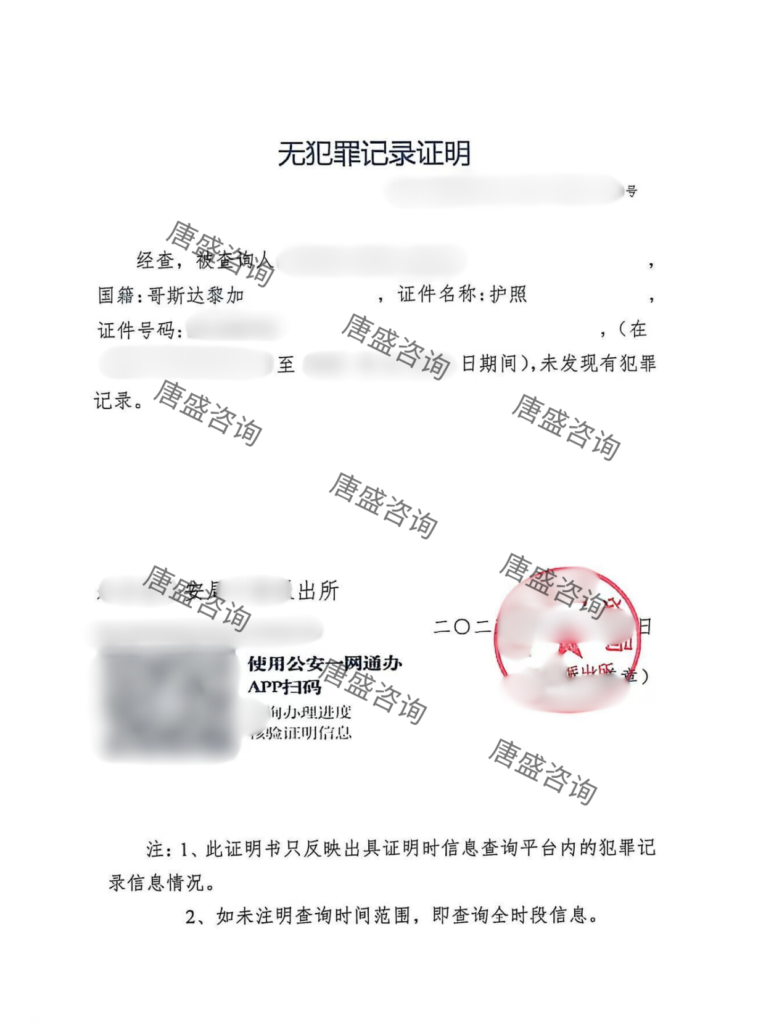
What Is a Police Clearance Certificate in China?
A Police Clearance Certificate issued in China confirms that an individual has no criminal record during a specified period of residence in China.
For foreign nationals, this certificate is commonly required for:
- Work visa or employment background checks
- Permanent residence or immigration applications
- Long-term residence permits
- Professional licensing or regulatory compliance abroad
- Marriage or family-related immigration procedures
The certificate is typically issued by the local Public Security Bureau (PSB) with jurisdiction over the applicant’s place of residence in China.
Why Notarization Is Required for Overseas Use
A police-issued certificate alone is usually not sufficient for use outside China.
Foreign authorities generally do not have the means to verify:
- The authenticity of the Chinese police document
- The identity of the applicant
- The issuing authority’s legal status
Therefore, the certificate must be notarized by a Chinese notary public, which legally confirms:
- The authenticity of the original police clearance certificate
- The identity of the applicant
- The validity of the document as an official public record
Only after notarization can the document proceed to international authentication.

Two Types of Police Clearance Notarization in China
In practice, there are two commonly used notarization formats, and the choice depends on the requirements of the destination country or authority:
- Notarization of the Police Clearance Certificate
- The notary certifies the authenticity of the police-issued document.
- Notarized Statement of No Criminal Record
- The notary issues a notarial certificate directly stating that the individual has no criminal record during the relevant period.
Both formats are legally valid, but acceptance depends on the receiving authority. Applicants should confirm which format is required before proceeding.
Apostille vs. Consular Legalization: Which One Applies?
After notarization, international authentication is usually required. The applicable method depends on whether the destination country is a member of the Hague Apostille Convention.
Apostille (Hague Convention)
If the document will be used in a country that is a Hague Convention member, the notarized certificate only needs an Apostille issued by the competent Chinese authority.
No further embassy legalization is required.
Common Apostille destination countries include:
- Germany
- France
- Spain
- Italy
- Netherlands
- Australia
- Japan

Consular Legalization (Double Authentication)
If the destination country is not a Hague Convention member, the document must go through consular legalization, which usually involves:
- Notarization in China
- Authentication by the Chinese Ministry of Foreign Affairs
- Legalization by the destination country’s embassy or consulate in China
Typical non-Hague countries include:
- United Arab Emirates
- Qatar
- Kuwait
- Thailand
- Vietnam
Can Foreigners Apply If They Have Left China?
Yes.
Foreign nationals who are no longer in China can still apply for police clearance, and its notarization and authentication through remote procedures.
Original documents are not required, and scanned copies can be used for preliminary review, followed by formal processing and international delivery.
Practical Considerations and Common Issues
- Issuing authority matters: The police certificate must be issued by the correct local PSB.
- Validity periods differ: Some immigration authorities impose time limits on police clearance certificates.
- Authentication route must match the destination country: Apostille and consular legalization are not interchangeable.
Confirming requirements in advance can help avoid delays or rejections.
Professional Assistance for Cross-Border Compliance
Handling police clearance certificates for foreign nationals involves coordination between police authorities, notary offices, and international authentication bodies.
For individuals who are overseas, short on time, or unfamiliar with Chinese administrative procedures, professional assistance can help streamline the process and reduce uncertainty.
Tangsheng provides support for:
- Police clearance certificate
- Police clearance notarization in China
- Apostille for Hague Convention countries
- Consular legalization for non-Hague countries
- Remote processing and international delivery
All procedures are handled in accordance with applicable regulations and destination-country requirements.


